Last updated on March 8th, 2026 at 05:54 pm

Fascinating Street Art: The Intriguing Venus of the Springs Mosaic at Hot Springs
“I thought it would be interesting to do an old master-like work to display the dichotomy of contemporary art with an old master theme — a juxtaposition of the two.” — Artist Patrick Cunningham
A Lucky Encounter in Hot Springs
Yes, there is such a thing as luck, and it struck us on October 13, 2022, as we were leaving downtown Hot Springs, Arkansas — we spotted the mosaic Venus of the Springs as a work in progress.
And lady luck gave us a rare opportunity: to speak to both the artist and the art patron in one place simultaneously — themselves two world-class talents in their respective fields.
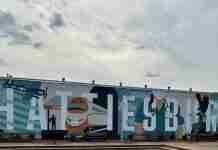
The work dominates the back wall of the Post Office building at Karicole Plaza, just steps from the heart of downtown Hot Springs along Central Avenue. Even in its unfinished state, the scale was striking: a towering female face rendered in rich golds, deep blues, and earthy tones, surrounded by swirling symbols and three-dimensional elements that jutted out from the wall. Part painting, part sculpture, part mosaic — it defied easy categorization. We stopped the car and walked over for a closer look.
The Venus of the Springs mosaic under construction in Hot Springs, Arkansas, October 13, 2022.
The Artist: Patrick Cunningham
We caught Patrick in the middle of his work, and he graciously stopped to talk with us about the project, its origins, and what drives him as an artist.
RoverTreks: Patrick, please tell us about this mosaic.
Patrick: About a year ago, I sold a small painting to the owner of the building. He later asked me to replicate the work into this giant mosaic which, as you see, is almost complete.
RoverTreks: So did this work have a special meaning for you as a source of inspiration?
Patrick: Oh yeah. I’m a big book collector and like to study the old masters. So I thought it would be interesting to do an old master-like work to display the dichotomy of contemporary art with an old master theme, a juxtaposition of the two. The works of the 16th-century Italian painter Titian inspired me to create the face. The swirls are from ancient petroglyphs that symbolize water.
The title of the painting is The Venus of the Springs. In Roman mythology, Venus was born from the sea. With the origins of her birth in mind, you’ll see a big seashell on the other part of the building — it’s just around the corner.
RoverTreks: So, have you been an artist your whole life?
Patrick: Oh yeah. Selling works. In my younger days, in my twenties, I was an electrician doing construction work, but I still sold artwork. So that construction work actually filtered over into my artwork because I fabricate sculptures, and this is a lot of fabrication for this mosaic. The work is really a mosaic more than it is a mural.
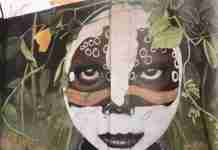
The original Venus of the Springs painting by Patrick Cunningham — the small work that inspired the monumental mosaic on the building.
As Patrick returned to his work, we turned to Thomas Nagin, the building’s owner, who had been listening nearby with a quiet smile. His connection to the piece, it turned out, ran just as deep — but from an entirely different direction.
The Art Owner: Thomas Nagin
RoverTreks: Thomas, please tell us about your interest in this work.
Thomas: Patrick did a painting for my wife with the lady [pointing to the painting nearby]. Patrick is into symbolism in his works, and we felt a connection to this particular work. We liked it so much I asked Patrick if he could replicate it on a building, and he said yes — and here we are [Thomas waves toward the building].
So, the face in the mosaic is influenced by the 16th-century Italian painter Titian. The gold leaf actually inspired us. My wife and I run a mining and jewelry company, and we’ve traveled all over the world, especially to South America, in connection with our work. The gold leaf on display in buildings in South America is a memory and inspiration for us, and this work is a connection to our work and our life. My wife uses gold leaf on works in our studio.

Art Owner Thomas Nagin (left) and Artist Patrick Cunningham (right) at the Post Office Building at Karicole Plaza in Hot Springs, Arkansas, during the layout of Venus of the Springs. October 13, 2022.

A chess piece — one of several three-dimensional symbols built off the wall and then attached to it.

A seashell evoking Venus’s mythological birth from the sea — found just around the corner of the building.
The Symbolism Behind the Mosaic
Venus & the Sea
In Roman mythology, Venus was born from the sea. The mosaic’s title connects the goddess of beauty to the thermal springs that give the city its name — water as a source of life and renewal.
Titian’s Influence
The face in the mosaic draws directly from the works of 16th-century Italian master Titian, blending Old Master portraiture with a contemporary street-art sensibility.
Ancient Petroglyphs
The swirling patterns surrounding the face are drawn from ancient petroglyphs that symbolize water — a nod to the deep human history of marking sacred places.
Gold Leaf & Mining
The gold leaf in the mosaic reflects Thomas and his wife’s career in mining and jewelry, and their memories of gold leaf displayed in South American buildings encountered during their travels.
About the Artist
Patrick Cunningham (who also goes by his Irish name, Giolla Patraic) is a Southern California–born artist whose lifelong passion for history and art led him to develop the Old Master style for which he is known. Working primarily in oil painting, he also creates portraiture, sculpture, and figurative abstractions. His studies have taken him to Ceri, a small Tuscan village, where he trained in fresco techniques under Italian masters, and to France, where he studied mural design. His work resides in private collections across the United States and Europe.
About the Art Owner
Thomas Nagin is a mineral dealer, documentary filmmaker, and owner of Crystal Springs Mining & Jewelry Co. in Hot Springs. Originally from the Washington, D.C., area, Thomas entered the mineral trade in the late 1970s on a buying trip to South America. His early finds earned him a sale to the Smithsonian Institution, launching a career that has grown to serve museums, collectors, and retailers worldwide. His adventures have included operating a quartz mine in Santander, Colombia, during the 1980s Emerald Wars, where he had to negotiate with armed guerrilla groups controlling the region.
Thomas also created and hosted Mineral Explorers, an unscripted reality series that aired on PBS stations across the country for four years, reaching approximately 90 percent of the U.S. market over 13 episodes and two seasons.
Our Verdict
A Must-See Gem of Public Art in Hot Springs
The Venus of the Springs is far more than a decoration on the back of a building. It is a convergence of classical painting tradition, contemporary street art ambition, ancient symbolism, and deeply personal meaning for both the artist and the patron who commissioned it. The craftsmanship — with its gold leaf, three-dimensional elements built off the wall, and mosaic techniques — places it in a class of its own among the public art we’ve encountered in our travels. If you find yourself in Hot Springs, do not miss it.
- Location
- Back of the Post Office building at Karicole Plaza, downtown Hot Springs, Arkansas, near Central Avenue. The name “Karicole” is a coinage derived from the names of Thomas Nagin’s daughters.
- Admission
- The mosaic is visible from the street and freely accessible to the public year-round.
- The Artist
- Patrick Cunningham (Giolla Patraic) — Email: [email protected] · Tel: (949) 354-8747 · Web: www.artkarma.com
- The Art Owner
- Thomas Nagin, Crystal Springs Mining & Jewelry Co. — 620 Central Ave. Suite 2G, Hot Springs, AR 71901 · Tel: (501) 623-2323 · Email: [email protected] · Web: crystalspringsmining.com
- Photo Note
- All photos in this article were taken in October 2022 while the mosaic was still under construction. Street art is ephemeral — always verify current status before making a special trip to see a specific work.
Editor’s Note
The comments of Patrick and Thomas have been lightly edited for clarity. We thank them both for their time and for their contributions to the world of public art in Hot Springs.