


Last updated on April 10th, 2026 at 02:58 pm
Greenland: A cultural, political, and geographic oddity
One of the most remote destinations on Earth — and now one of the most consequential. A place where Inuit heritage, Danish governance, Arctic wilderness, and great-power politics collide.

Greenland tops our list as a destination that defies easy categorization. Geographically North American, politically tied to Europe, culturally Inuit — and now at the center of a global contest over sovereignty, resources, and the future of the Arctic.
This is one of the most out-of-the-way destinations on Earth. It's a place you'd hardly give a thought to visiting unless you're a researcher studying the polar ice caps, global warming, or Indigenous cultures.
Yet, if you live in the Americas, it's in your continental backyard since it's part of North America geographically. Politically, it is an autonomous territory within the Kingdom of Denmark, with its own parliament and self-governing authority over most domestic affairs. Culturally, its people are predominantly Inuit — descendants of the Thule people who migrated from the North American mainland centuries ago — making up most of its approximately 57,000 inhabitants.
Those features alone make Greenland singular. But here is what truly sets it apart: this is a place that will not change significantly unless the Greenland ice cap retreats — or unless the geopolitical forces now swirling around it reshape its future first.
The Landscape: Cruising the Prince Christian Sound
Some places on this Earth are just easier to visit by boat. Greenland is one of them. That's how we ended up visiting the two coastal towns of Qaqortoq and Nanortalik during the summer of 2016.
Cruising the Prince Christian Sound was our first exposure to this country. It's a marine channel in West Greenland and one of the most beautiful cruise experiences on earth.

Navigation of this waterway is tricky, even during the summer, because of the number of icebergs the Greenland ice cap produces all year long. Sometimes helicopter surveillance is necessary to ensure that a vessel getting into the sound can also get out.
But once you're inside this area, the views are stunning. Steep glaciers project their alien-like shapes carved out during the last ice age, rendering an otherworldly look to the landscape. At some point it becomes obvious that cameras simply cannot capture this grand display by Mother Nature. Black and white photos are a great alternative for photographers.
The Prince Christian Sound presents a stark, natural beauty regardless of the weather. A sunny day reveals sparkling white and blue ice amidst the sheer, near jet-black cliffs. A misty or cloud-shrouded day only adds mystery to the atmosphere of this millions-of-years-old natural phenomenon of glaciers, steep fjords, and plummeting waterfalls fed by the enormous force of the Greenland ice cap.
The People: Inuit Culture at the Edge of the World
Most inhabitants of Greenland are Inuit, living in coastal towns since conditions are harsh — if not impracticable — in the ice-cap-bound interior.

The only way to get around is by helicopter, boat, or bush plane. There are few roads outside the small coastal towns. In fact, Air Greenland vehicles are a common sight throughout the country.

Qaqortoq and Nanortalik are two small coastal towns on the southern tip of Greenland. Qaqortoq has a population of roughly 3,100, while Nanortalik is home to about 1,300 people.

Fishing is the primary industry here. Boats large and small decorate the harbors of coastal towns around the perimeter of the island. Yet many supplies are shipped in from other continents, with Denmark taking the lead in this respect.


The language
Take a look at the signs. The official language of the country is Kalaallisut (West Greenlandic), part of the Inuit-Aleut (Eskaleut) language family spoken by Arctic peoples from Siberia to eastern Greenland. Although related, speakers of regional dialects find them to be mutually unintelligible given the vast distances and isolation separating communities across the polar ice cap. In the mid-19th century, a Moravian missionary devised an alphabet for the language using Roman Latin characters. Today, Kalaallisut is the sole official language of Greenland, with Danish widely spoken as a second language and taught in schools.


The structures
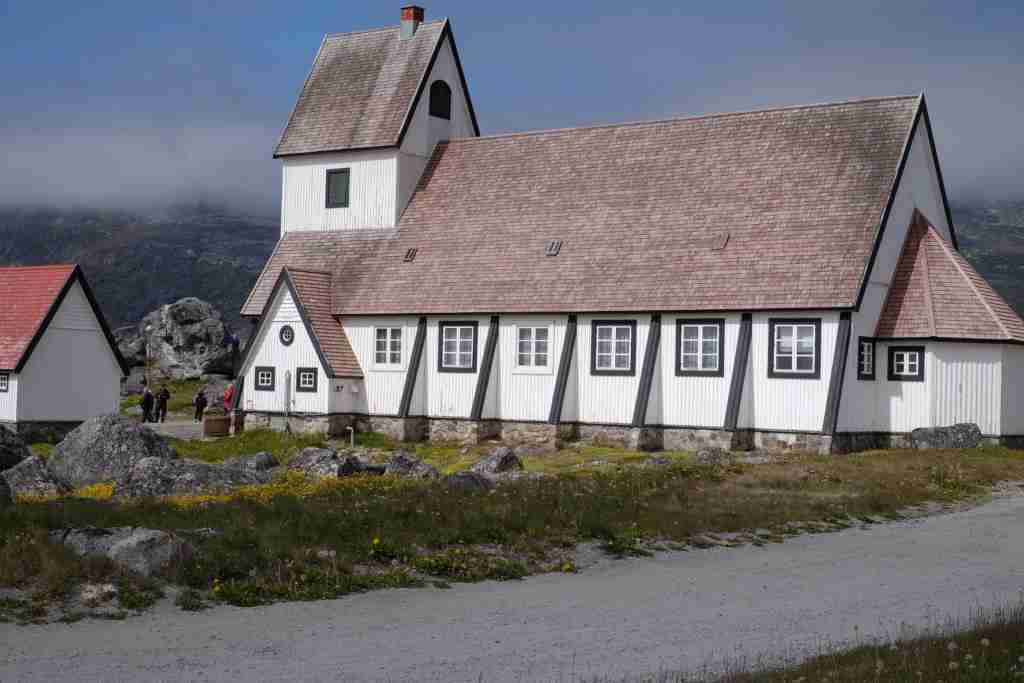
Take a look at the buildings. Tough, sturdy materials forged to withstand a harsh, often foreboding climate, cling to the land — tempered by generations of ingenious construction methods known to withstand the test of time.


Little goes to waste in these towns. This bar features the front end of a Volkswagen jutting out of a sidewall to attract patrons — a resourceful bit of Arctic ingenuity that doubles as the most unforgettable landmark in town.

The Moment: Greenland on the World Stage
When we visited in 2016, Greenland was a quiet curiosity on most travelers' radars. That is no longer the case. Since 2019, the island has been thrust into a geopolitical firestorm that has made it front-page news around the world.
President Trump first proposed purchasing Greenland from Denmark in 2019. After returning to office in January 2025, he intensified the push — at one point declining to rule out the use of military force. Vice President JD Vance visited the U.S. base on the island in March 2025. Denmark and Greenland's leaders responded firmly that the island was “not for sale,” and European allies issued joint statements supporting Greenland's sovereignty.
The pressure from Washington accelerated Greenland's own independence movement. In March 2025, a snap election dominated by the sovereignty question delivered a surprise victory to the center-right Demokraatit party, led by new Prime Minister Jens-Frederik Nielsen, who favors a gradual, pragmatic path to independence. The opposition Naleraq party, which advocates swifter separation, won its first-ever seat in the Danish parliament in a March 2026 election with a strong 24.6% of the Greenlandic vote.
Polls show that roughly 84% of Greenlanders support independence from Denmark — but a majority want it only if it does not lower their standard of living. Denmark currently provides an annual block grant equal to about two-thirds of Greenland's government budget. A commission tasked with mapping the legal process for activating independence under the 2009 Self-Government Act is expected to report its findings in late 2026.
For travelers, the practical effect is this: Greenland is no longer remote in the public imagination. Tourism is growing rapidly, infrastructure is expanding, and the island's people are actively shaping their future. It is a destination that feels like it is on the edge of something historic — because it is.
Why Go to Greenland?
Greenland presents an astonishing collection of sights and experiences found few other places on Earth. The landscape is otherworldly — glaciers calving into fjords, icebergs drifting past colorful coastal villages, and a silence so complete it feels physical.
Most visitors come for one of several reasons. Day-trippers aboard cruise ships stop to experience the raw visual impact of the place. Adventure travelers come to kayak among icebergs, dogsled across the ice cap, hike the Arctic tundra, or go whale watching along the coast — humpbacks, minke, and fin whales are commonly sighted in summer. The Northern Lights draw winter visitors who can witness some of the most vivid auroral displays anywhere on the planet. And researchers continue to visit to study the polar ice cap, climate change, and Indigenous cultures.
What you may not expect is the warmth of the welcome. Greenlanders are known for their hospitality — visitors are often invited to a kaffemik, the traditional Greenlandic gathering over coffee and cake in a local home.

Planning Your Trip
When to go
You can visit Greenland year-round, though the experience changes dramatically by season. Summer (June through August) offers the widest range of travel choices: cruise ships call at southern ports, hiking and kayaking conditions are at their best, and the midnight sun means nearly 24 hours of daylight. Winter visitors come for the Northern Lights, dogsledding, and the stark beauty of the polar dark. The official tourism site, Visit Greenland, offers a comprehensive catalog of organized tours and experiences across all seasons.
How to get there
By air
Getting to Greenland by air has become dramatically easier. Nuuk's new international airport opened in November 2024 with an extended runway capable of handling transatlantic jets — a transformational moment for the country. Two additional airports at Ilulissat and Qaqortoq are scheduled to open by the end of 2026.
Air Greenland operates frequent flights from Copenhagen to Nuuk year-round, plus seasonal service to Kangerlussuaq and Narsarsuaq. Icelandair offers year-round connections from Reykjavík to Nuuk, Ilulissat, Kulusuk, and Narsarsuaq. And in a landmark first, United Airlines launched seasonal nonstop service from Newark to Nuuk in summer 2025 — a four-hour flight on a Boeing 737 MAX 8, operating twice weekly, with the route confirmed to return in summer 2026. You can search for fares and schedules through our travel partners below.
By sea
Several commercial cruise lines offering transatlantic passage stop at Nuuk, Qaqortoq, and Nanortalik during the summer months. Expedition and small-ship operators offer more intimate itineraries. Our 2016 visit was aboard the MS Rotterdam with Holland America Line, which offers various cruises spanning Greenland, Iceland, the Faroe Islands, the Shetlands, and the coast of Norway.

Where to stay
Accommodations range from hotels in Nuuk and the larger towns to guesthouses, hostels, and wilderness lodges. Availability can be limited, especially in summer and particularly in smaller communities — book as far ahead as possible. You'll find booking options through our recommended travel partners below.
A final word
Greenland is not a destination you visit casually. It is a place that rearranges your sense of scale — the ice, the silence, the distances between communities, the weight of a culture that has survived at the edge of the habitable world for centuries. And now, at a moment when its people are deciding their own future, a visit to Greenland feels less like tourism and more like witnessing history in real time. Go — but go with the respect this extraordinary place deserves.