Last updated on March 17th, 2026 at 11:56 am
Views of the Taku Glacier, Juneau, Alaska
A Helicopter and Airboat Tour of the World's Thickest Alpine Glacier — and What Its Future Tells Us
—
Alaska had been on the travel list for years, and a Holland America cruise through the Inside Passage finally made it happen. As the ship made its port call in Juneau — the only U.S. state capital unreachable by road — it was immediately clear that the city was designed for people who want to go further. Float planes buzz the harbor. Helicopter companies line the waterfront. And everywhere, the signs promised the same thing: glacier.
The tour of choice was the Taku Glacier Helicopter and Airboat Adventure, booked in advance through Holland America before the cruise departed. The operator, NorthStar Helicopters, has been running glacier tours from Juneau since 1998 and holds the distinction of being the only operator offering this specific combination of helicopter flight, airboat river cruise, and glacier landing at the Taku — one of the most remote and spectacular corners of Southeast Alaska.
“Flying over the Juneau Icefield, with 1,500 square miles of ancient ice unfolding below, the word ‘vast' feels completely inadequate.”
HOW THE TOUR WORKS
The Taku Glacier Helicopter and Airboat Adventure was booked as a Holland America shore excursion before the cruise departed. The operator, NorthStar Helicopters, has been running glacier tours from Juneau since 1998. A van shuttle from the cruise ship dock carries passengers across the Gastineau Channel to NorthStar's seaside base on Douglas Island — the launch point for all Taku airboat tours. After a gear fitting (over-boots, rain pants, flotation device) and a pre-flight safety briefing, passengers board one of NorthStar's A-Star turbine helicopters.
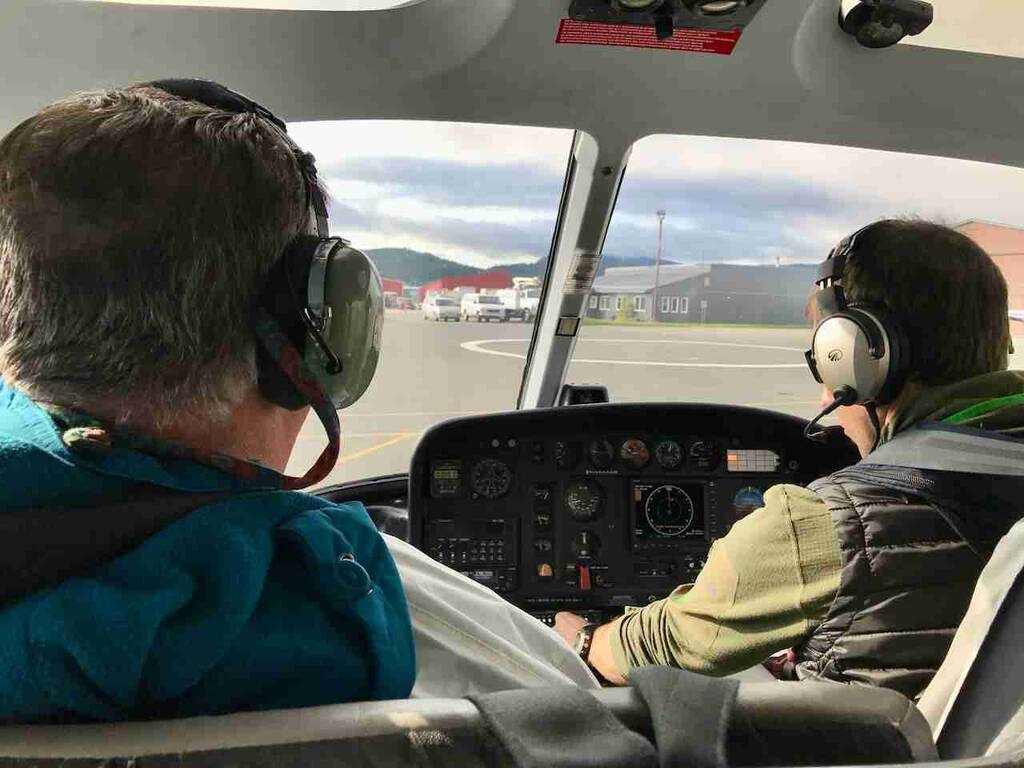
The flight route to Taku Point is the pilot's choice, guided by weather and visibility. On a clear day it traces a corridor over the old-growth Tongass National Forest, through the dramatic peaks of the Coast Mountains, and out over the glacier system. It takes only minutes to travel from temperate rainforest at sea level to a world of ancient ice and silence — a shift in landscape so abrupt it feels almost theatrical.
THE VIEW FROM ABOVE: GLACIERS OF THE JUNEAU ICEFIELD

Flying over the Juneau Icefield, the word “vast” proves completely inadequate. Glacier after glacier fills the view below — rivers of compressed ice carving valleys, splitting around peaks, pooling in basins. The Taku is the largest of them, and the most storied. As the helicopter descends toward Taku Point, its five-mile terminus comes into view: a wall of ice and blue shadow rising from the river below.
ON THE TAKU RIVER BY AIRBOAT
Upon landing at Taku Point, the airboat crew takes over. This is not a conventional motorboat — an airboat is a flat-bottomed craft propelled by an aircraft-type propeller mounted at the stern, purpose-built for navigating shallow glacier-fed rivers where a conventional hull would ground out. The Taku River basin is one of the most pristine stretches of water in Southeast Alaska, and the airboat is the only practical vessel for reaching the glacier's face from the water.
The boat is covered with open sides, and passengers sit facing forward as it accelerates down the river toward the glacier terminus. The airboat captain narrates throughout, describing how the Taku River has been carved and reshaped over centuries by the advancing ice, and pointing out wildlife — bears, eagles, and mountain goats are occasional visitors to the riverbanks.

The scale of the glacier becomes visceral from the water in a way it simply is not from the air. The Taku's terminus stretches five miles across — the airboat cruises its full length, coming within arm's reach of the ice face at several stops. Towers of blue-white ice rise overhead. The silence between engine cuts is total, broken only by the occasional deep crack of ice shifting in the river.
SETTING FOOT ON THE ICE
After the airboat portion, the helicopter retrieves passengers at Taku Point for the short flight up to the glacier surface. The tour includes approximately ten minutes on the ice — enough for photographs, a pilot-guided orientation, and a few moments of genuine stillness in one of the most remote places in Alaska.

The ice beneath is not white, as it appears from a distance. Up close, it grades through pearl and gray into deep, compressed azure — a blue that comes from centuries of snow being compacted until all air is forced out and only the ice's own density remains. The surface is textured with ridges, meltwater channels, and crevasse fields visible in the distance. Standing on it, the 1,480-meter depth of ice below is almost impossible to comprehend.

ABOUT THE TAKU GLACIER
The Taku — known as T'aaḵú Ḵwáan Sít'i in the Tlingit language of the Indigenous people who have inhabited this region for thousands of years — is the largest glacier in the Juneau Icefield and one of the most scientifically significant glaciers in the world. It is approximately 55 kilometers long and measures nearly 1,480 meters from surface to bedrock, making it the thickest known alpine temperate glacier on Earth.
The Taku is a tidewater glacier, meaning it historically interacted directly with the ocean — calving icebergs into Taku Inlet. By 1948 the glacier had advanced far enough to ground its terminus on its own outwash sediments, ending the calving phase and allowing it to continue a steady advance that would last for decades. It is located approximately 30 kilometers northeast of Juneau, accessible only by air or careful boat navigation — which is what makes the NorthStar tour so distinctive.
WHAT HAS CHANGED SINCE OUR VISIT:
THE LAST ADVANCING GLACIER HAS BEGUN TO RETREAT
For most of the past century, the Taku Glacier was a celebrated scientific anomaly: the only glacier among all 19 major glaciers of the Juneau Icefield that was advancing rather than retreating. Glaciologist Mauri Pelto spent four decades monitoring 250 glaciers around the world and watched every one of them shrink — except Taku. It was the one he held onto.
In 2019, NASA satellite imagery confirmed that the Taku had joined the rest. After a brief pause in advance from 2013 to 2018, the glacier entered a retreat phase — losing mass at an average rate of 1.3 meters per year since 2013, with a record mass loss in 2019 coinciding with the warmest Alaskan year on record. Scientists at the University of Alaska and the U.S. Geological Survey describe the transition as unusually rapid, with climate warming overriding the glacier's natural tidewater cycle.
This context transforms a visit to the Taku from a spectacular excursion into something more resonant: a chance to witness, in real time, one of the most dramatic climate stories playing out anywhere on Earth.
Key facts:
– 55 km — length of glacier
– 1,480 m — maximum depth; deepest known alpine temperate glacier
– 1.3 m/yr — average ice thinning since 2013
– 70+ years — of continuous scientific monitoring since 1946
OUR VERDICT: WORTH EVERY DOLLAR — AND EVERY REASON TO GO SOON
The Taku Glacier Helicopter and Airboat Adventure is the kind of experience that resets a traveler's sense of scale. From the helicopter's vantage point over the Juneau Icefield, to the airboat skimming within arm's reach of a glacier face, to standing on ice nearly a mile deep — it is layered in a way that few excursions manage. Holland America's booking process made it seamless from the ship, and NorthStar's guides were knowledgeable and unhurried. Book through your cruise line or directly at northstartrekking.com. And book now: the glacier that waited a century to show signs of change is changing faster than anyone expected.
FREQUENTLY ASKED QUESTIONS
How do cruise ship passengers book this tour?
Holland America offers the NorthStar Helicopters Taku Glacier Airboat and Helicopter Adventure as a bookable shore excursion, available online before the cruise or through the ship's shore excursion desk. Most major cruise lines that call at Juneau offer comparable access. Independent travelers can book directly at northstartrekking.com. NorthStar provides van shuttle service from the cruise ship dock — no separate transportation is required. Book at least one hour after your ship's scheduled arrival and ensure the tour concludes no fewer than 45 minutes before departure.
What is the current price, and what does it include?
As of 2025, the Taku Glacier Helicopter and Airboat Adventure is priced at $688 per person when booked directly through NorthStar Helicopters. The tour includes approximately 30 minutes of helicopter flight time, one hour of airboating along the glacier's five-mile terminus, and at least 10 minutes on the glacier surface. NorthStar provides over-boots and rain pants; guests are advised to dress in warm layers suitable for temperatures 10–15°F cooler than sea level. Pricing through cruise lines may vary. Always verify current rates at northstartrekking.com before planning.
Is the Taku Glacier actually retreating now?
Yes. After advancing continuously since at least 1890 — and being the only glacier in the Juneau Icefield not losing mass for most of the past century — the Taku Glacier entered a retreat phase confirmed by NASA satellite imagery in 2019. The glacier had a brief pause in advance between 2013 and 2018, then began thinning at an average of 1.3 meters per year, with record ice loss in 2019. Scientists at the U.S. Geological Survey and the Juneau Icefield Research Program attribute this to regional warming that has been overriding the glacier's natural tidewater cycle. The NorthStar airboat tour continues to operate, and the glacier remains accessible and extraordinary — but its long-term trajectory has fundamentally changed.
What are the physical requirements for this tour?
The Taku Airboat and Helicopter Adventure is rated easy to moderate. Participants must be at least 7 years old and able to ascend and descend two flights of stairs independently. NorthStar staff cannot lift guests into or out of the helicopter. Guests weighing 250 pounds or more are subject to a $150 surcharge due to aircraft weight and balance requirements. Weather in Juneau is frequently overcast and rainy; tours are canceled approximately 10% of the time due to conditions, with full refunds issued. NorthStar typically does not make cancellation decisions until within one hour of departure.
What is the significance of the Tlingit name for the glacier?
The Tlingit people — the Indigenous inhabitants of Southeast Alaska, including the Juneau region — have known and named this glacier for centuries. Its Tlingit name, T'aaḵú Ḵwáan Sít'i, reflects a deep cultural and practical relationship with the land, the river, and the ice. The Taku River, which flows alongside the glacier's terminus, has historically been a vital salmon corridor and travel route for Tlingit communities. The glacier's advance, which at various points has blocked and rerouted the river, has been documented in Tlingit oral history as well as in Western scientific records dating to the mid-18th century.
VISITOR INFORMATION
Tour Operator: NorthStar Helicopters (NorthStar Trekking)
Douglas Island Base: 6910 N Douglas Hwy, Juneau, AK 99801
Phone: (907) 586-2030
Website: northstartrekking.com
Tour: Taku Glacier Helicopter & Airboat Adventure
Duration: 3.25 hours total (~30 min helicopter, ~1 hr airboating, ~10 min on glacier)
Ages: 7 and older
Activity Level: Easy/Moderate
Price: $688 per person (2025; verify at northstartrekking.com)
Booking: Available as a Holland America shore excursion and through most major cruise lines. Also bookable directly at northstartrekking.com. Shuttle from cruise dock is included.
What to Wear: Warm layers (long sleeves, fleece), long pants, sturdy shoes with high socks. NorthStar provides over-boots and rain pants. Expect temperatures 10–15°F cooler on the glacier than at sea level in Juneau.
Glacier Facts: Taku Glacier (T'aaḵú Ḵwáan Sít'i) · ~55 km long · 1,480 m thick — world's thickest known alpine temperate glacier · Largest glacier in the Juneau Icefield · In retreat since 2018–2019 after more than a century of advance.
Photo Note: Photos in this article are from a 2018 visit. The glacier's appearance and conditions change from year to year. Current imagery is available through NorthStar's website and social media channels.