Last updated on April 7th, 2026 at 04:16 pm
How to Rove | Boating & Cruising
Cruise Your Way to a New Life
When you stop measuring travel by how fast you get there, the ship itself becomes the destination — and crossing an ocean by sea changes everything.
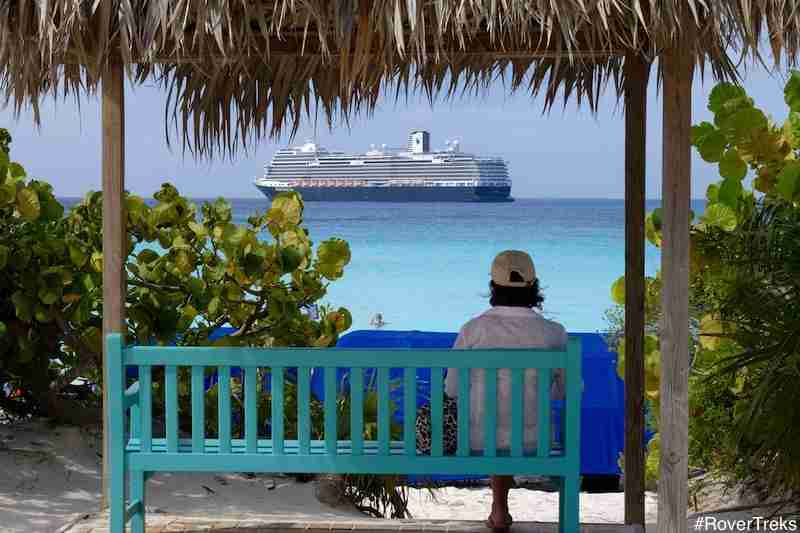
Watching a cruise liner arrive at Half Moon Cay, Bahamas. Photo: RoverTreks
“Once you remove ‘time' and ‘anchors' as travel constraints, the ship stops being transportation — and starts being the journey itself.”
There are many ways to rove the world. Most people fly — it's fairly cheap and fast. And most are single-destination travelers. They'll fly to and hang out in a city or town, or simply explore a geographic region. Time and money drive this behavior.
But let's face it: flying is a hassle. Many people wouldn't do it at all if time weren't a factor.
If you're a rover — especially a full-timer — time isn't always driving your travel train. You're always traveling. You've got all the time in the world. If you weren't where you are right now, you'd be somewhere else, to overstate the obvious.
Get Rid of Your Anchors to Set Sail for Freedom
Once you've shed your “anchors” — a house, kids, pets, or a job tethering you to one location — time becomes relevant only for staging travel from one area to another. It becomes a question of logistics: where do I need to be, and when, to catch my next ride to destination X?
When you start thinking this way, you open your mind to possibilities about modes of transportation over time, rather than treating destinations as the only goal. Stated differently, the mode of transportation becomes a destination worthy of exploration in its own right — on the way to somewhere else.
Once you eliminate “traveling quickly” as a constraint, cruising becomes a real option. And yet, like many of us, you've probably thought about it and talked yourself out of it — time, money, fear, health concerns, arrogance, or the occasional horror story on the evening news.
Arrogance and negative headlines were my excuses. Years ago, I lived and worked on aircraft carriers and various classes of naval vessels. My attitude was: how could a commercial cruise line possibly match the U.S. Navy? That bias, combined with well-publicized cruise ship incidents — pandemic illnesses and accidents at sea — reinforced my skepticism.
But I was wrong.
In 2015, my wife and I took our 26-year-old son and a friend on a two-week Mediterranean cruise aboard Norwegian Cruise Line (NCL). Since then, we've completed two trans-Atlantic crossings and a Panama Canal transit with Holland America. I'm now a genuine convert. When I think about reaching another continent, my first question is: is there a cruise that gets me there?

The Azores, Portugal — a mid-Atlantic archipelago most travelers never see because they fly over it. A trans-Atlantic repositioning cruise makes it a natural port of call. Photo: RoverTreks
Why Every Rover Should Consider Cruising
Cruising is one of the finest ways to see the world — and repositioning cruises are the best of the best for rovers. These are sailings in which a cruise line moves a ship from one region to another at the start or end of a season — and sells the passage at a steep discount to fill the cabins. They're an affordable, unhurried way to cross from one continent to another.
Consider what a cruise actually provides that a flight never can: a hotel room and three meals a day while you travel from point A to point B. Shore excursions — real stops in real places — along the way. Entertainment, exercise facilities, swimming pools, and the rare luxury of arriving somewhere fully rested. A cruise is a floating hotel on the move.
We've met full-time travelers who cruise by a simple rule of thumb: if a repositioning cruise costs $100 per person per day or less, they take it. Once you account for accommodation, meals, and entertainment bundled into that rate, it's genuinely hard to beat.
When evaluating a repositioning cruise, divide the total fare by the number of days. If you land at or under $100 per person per day, you're likely getting an excellent deal — once meals, lodging, and entertainment are factored in.
Beyond the economics, cruising solves one of the most persistent stresses of full-time travel: where will I sleep tonight? A cruise provides a stable, full-service, temporary home — your cabin, your routine, your dinner table. Many seniors have discovered this and turned cruising into a permanent way of life.
And then there's the geography. Water covers approximately 71 percent of Earth's surface. Many of the world's most remarkable places are accessible, in practical terms, only by boat. When you start moving between continents by sea, entirely new possibilities open up.
The Rover Playbook
Two Repositioning Routes That Will Change How You Think About Getting There

Trans-Pacific Route
Vancouver to Yokohama — Through the Northern Pacific
Instead of enduring a 22-hour trans-Pacific flight, consider catching a Holland America repositioning cruise from the West Coast to Japan in September. Stops include Ketchikan, Juneau, Glacier Bay, Dutch Harbor, Kushiro, and Hakodate before arriving in Yokohama-Tokyo. From there, a short flight reaches anywhere in Southeast Asia. The return repositioning cruise departs the Far East in April — bookending an entire winter on the other side of the world.

Trans-Atlantic Route
Fort Lauderdale to Copenhagen — A Europe Doorstep Delivery
Holland America's 18-day April sailing from Fort Lauderdale deposits you in Copenhagen having passed through the Azores, Spain, France, Belgium, the Netherlands, and Denmark — never setting foot in a terminal. Arrive relaxed and drive the continent, island-hop to Greece, or catch the Baltic cruise immediately. Stay two months and ride the return repositioning cruise from Rotterdam to the U.S. — a complete loop, zero flights required.
The Rover Verdict
Stop Flying Past the World. Start Sailing Through It.
The hardest part of becoming a cruise convert is unlearning the instinct to get somewhere fast. Once you do, a repositioning cruise stops being a novelty and becomes your default intercontinental strategy. You arrive at the next chapter of your life relaxed, unhurried, and full of stories from the crossing itself — not just the destination. That's what roving is supposed to feel like.
Plan Your Repositioning Cruise
Pricing note: All fare figures in this article reflect 2017 research by the author. Current repositioning cruise rates vary significantly by season, cruise line, cabin category, and booking timing. Always verify directly with the cruise line or a travel specialist before planning.